PDF DRM for Consultants and Coaches: Protect Client Materials and Paid Frameworks
Consultants and coaches often sell knowledge in PDF form: frameworks, playbooks, audit reports, worksheets, templates, client manuals, onboarding packs, and workshop materials.
Those files are valuable because they can be reused. That is also why they are easy to leak.
If a client receives the raw PDF, they can forward it to another team, reuse it after the engagement ends, or share it with people who never paid for the work. You may still trust the client, but you have lost technical control.
MaiPDF gives independent experts and service teams two options:
- Online Cloud Sharing for fast client links, QR codes, expiry, view limits, watermarks, and open records.
- App DRM /
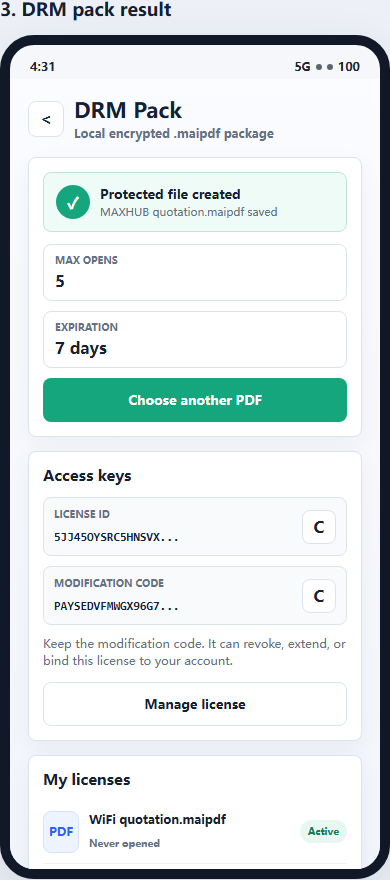
.maipdffor higher-value frameworks that should stay device-bound, revocable, and protected inside an app reader.
What consultants usually need to protect
Common high-value PDF assets include:
- strategy frameworks
- coaching worksheets
- workshop workbooks
- pricing models
- client audit reports
- onboarding manuals
- training playbooks
- certification materials
- paid template packs
Some of these are meant to be easy to read and share inside the client organization. Others are the actual paid intellectual property.
Use Online Cloud Sharing for client convenience
For normal client collaboration, a managed browser link is often enough.
Online Cloud Sharing lets you:
- send a link instead of a raw attachment
- set an expiry date for the engagement window
- limit opens for short review materials
- add dynamic watermarks
- disable download and print in the online viewer
- track whether the client opened the file
- replace or disable access later
This works well for proposals, meeting follow-ups, light worksheets, event materials, and documents where easy access matters more than strict lock-down.
Use App DRM for your reusable IP
If the PDF contains a framework you sell repeatedly, App DRM is the stronger path.
A protected .maipdf file is opened in the MaiPDF App, where access can be tied to license rules. That makes it more suitable for:
- premium coaching workbooks
- paid template packs
- repeatable consulting frameworks
- certification materials
- partner-only manuals
- client deliverables that should expire after the contract
Controls can include device binding, license revocation, expiry, and visible watermarks.
When a client asks, “Can you just send the PDF?”
A simple answer is:
“For convenience, I can send a browser reading link. For the paid workbook or proprietary framework, I use a protected reader so access can expire or be revoked after the engagement.”
This frames DRM as normal professional delivery, not distrust.
Practical setup by use case
| Use case | Suggested delivery |
|---|---|
| Sales proposal | Online Cloud Sharing with expiry |
| Meeting handout | Online Cloud Sharing |
| Client audit report | Online link + watermark or App DRM |
| Paid template pack | App DRM / .maipdf |
| Coaching workbook | App DRM / .maipdf |
| Workshop material | Online link for light files; App DRM for paid core workbook |
| Certification guide | App DRM / .maipdf |
Security boundary
No PDF DRM tool can make information impossible to copy. A reader can still take notes, summarize ideas, or photograph the screen with another device.
The useful goal is practical risk reduction:
- fewer uncontrolled attachments
- shorter access windows
- traceable leaks
- easier revocation
- device-level friction for casual sharing
- clearer separation between free samples and paid IP